May 23
Anne of AvonleaMay 23 is the date attached to one of the novel’s most consequential weather predictions: a storm forecast that proves strikingly accurate in its day, if not its hour, before hail devastates Avonlea. The date links a newspaper joke and a stretch of ordinary school life to a sudden disaster whose effects reach across the province.
A Date in the Newspaper
One of two notes in the Charlottetown Daily Enterprise’s Avonlea column predicted that Uncle Abe, the village weather prophet, expected a violent thunderstorm on the evening of May 23, beginning at seven o’clock and extending over most of the province. The column was written by Gilbert Blythe with Anne Shirley’s help; the authorship was disguised, including through a note that appeared to mock Gilbert. The forecast gave the date a public life before the storm itself arrived, inviting readers to treat Uncle Abe’s prediction as a local curiosity.
The prediction was not wholly invented for the column: Uncle Abe had forecast a storm for sometime that spring. The conspicuous precision of May 23, and the confidence of the forecast, made the date memorable. When the weather did break, the prediction’s broad outline would be vindicated, while its advertised hour would not.
The Storm Arrives Early
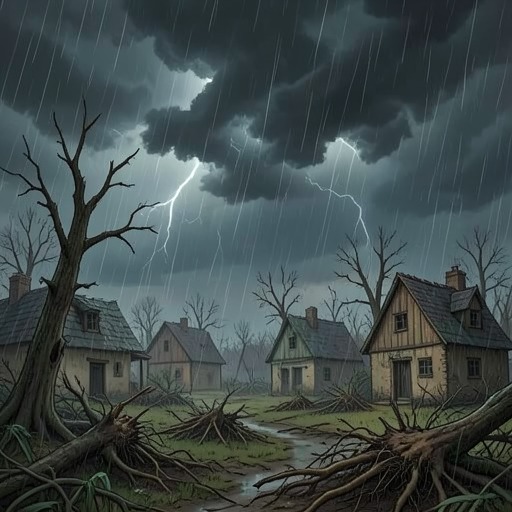
May 23 was unseasonably warm. Anne Shirley and her pupils spent the morning sweltering over fractions and syntax in the Avonlea schoolroom. A hot breeze gave way after noon to heavy stillness, and at half past three Anne heard thunder. She dismissed the children so they could get home before the storm, but the dark cloud was already gathering as they left the playground.
Anne hurried Davy and Dora Keith along Birch Path, past Violet Vale, and back to Green Gables. They reached the house just as the light vanished beneath the cloud. Hail followed with thunder and lightning, lasting three quarters of an hour. The storm broke every pane in the west and north windows of the house; hailstones poured inside and covered the floor. Marilla Cuthbert, Anne, and the twins took shelter in the kitchen, where the children’s sharply different reactions—Davy’s fear and Dora’s composure—made the danger immediate without diminishing the force of the storm outside.
Damage and Aftermath
When the hail melted three or four days later, the damage became clear. A deep carpet of hailstones had covered the ground, and the storm had cut down growing plants in fields and gardens. Apple-tree blossoms were stripped away, large branches were torn off, and most of the two hundred trees planted by the Improvers were snapped or shredded. The forecast’s arrival thus marked not merely a dramatic change in the weather but the destruction of crops and of a substantial communal planting effort.
The consequences extended beyond Avonlea. The following day, villagers visited one another to compare damage, while roads remained impassable to wheeled traffic. Late-arriving mail reported deaths and injuries, disrupted telephone and telegraph service, and the loss of young livestock left in the fields. The date’s newspaper prediction had announced a storm over much of the province; the aftermath confirmed that the disaster was larger than a single village’s experience.
Narrative Significance
May 23 carries an irony of precision and miscalculation. The storm comes on the predicted day, but well before the predicted seven o’clock start. Uncle Abe enjoys his vindication in the wake of the disaster, overlooking the discrepancy in the hour. The date therefore turns playful public forecasting into a measure of real communal vulnerability: what had sounded like a boast becomes a warning whose consequences are visible in broken windows, ruined trees, damaged farms, and reports from across the province.